Step 1: Identify the application
HDPE pipe selection begins with application. Is it potable water distribution, sewage rising main, gas distribution, industrial process, sprinkler irrigation, mining slurry or telecom ducting? Each application maps to a specific Indian Standard: IS 4984:2016 for water supply, IS 14333 for MDPE gas, IS 14151 for sprinkler irrigation, IS 16098 (Part 2) for DWC sewerage, and TEC/IS 14930 for PLB ducts.
Step 2: Determine the operating pressure
Operating pressure includes static head, pump discharge pressure and surge (water hammer) allowance. Multiply the peak operating pressure by a safety factor (typically 1.25–1.5) and round up to the next standard PN rating. PN 2.5, PN 4, PN 6, PN 8, PN 10, PN 12.5 and PN 16 are standard for HDPE. For Jal Jeevan Mission village lines, PN 6 is common; for zonal mains, PN 10; for industrial gas, PN 12.5 or PN 16.
Step 3: Choose the material grade
PE 63 is the base grade for low-pressure applications and legacy specifications. PE 80 is the workhorse for water supply. PE 100 is preferred for high-pressure applications and gas distribution because of its higher Minimum Required Strength (MRS) of 10 MPa versus 8 MPa for PE 80. Higher MRS means thinner walls for the same PN, saving material cost on large-diameter mains.
Step 4: Size the pipe hydraulically
Use the Hazen-Williams or Darcy-Weisbach equation to size for the design flow and permitted head loss (typically 3–5 m per km for distribution lines). HDPE has a very smooth inner surface (Hazen-Williams C-factor of 150 versus 100 for old steel). Once you calculate the internal diameter, choose the nearest standard OD (Outer Diameter) considering the wall thickness for your PN.
Step 5: Verify dimensional tolerances
IS 4984:2016 Table 4 specifies OD tolerances (e.g., 0.3 mm for 20–75 mm OD; 0.4 mm for 90–125 mm) and wall thickness tolerances. Ovality is limited to 2 percent of OD for pipes up to 200 mm and 2.5 percent for larger sizes. Reject dispatches that fail these tolerances.
Step 6: Specify jointing method
For OD 90 mm and above — butt fusion. For OD below 90 mm and in-line repairs — electrofusion couplers. For quick, portable applications like sprinkler pipes — quick-coupled joints. For temporary or removable connections — flange adapters with stub ends. Match your fittings inventory to the pipe grade and PN.
Step 7: Confirm marking and traceability
Every HDPE pipe must carry: manufacturer name (Almax Polymers), IS 4984:2016, grade (PE 63/80/100), OD, wall thickness, PN, batch and shift code, BIS licence number and manufacture date. Marking interval: not more than 1 metre. Traceability is essential for warranty claims and third-party inspection.
Step 8: Ask for MTC and TC
Every dispatch should carry a Manufacturer’s Test Certificate (MTC) covering dimensional, MFI, density, carbon-black, hydrostatic pressure and OIT results for the specific batch. Raw material Test Certificate (TC) from the polymer producer should also be furnished on request — particularly for government tenders.
Step 9: Storage and handling
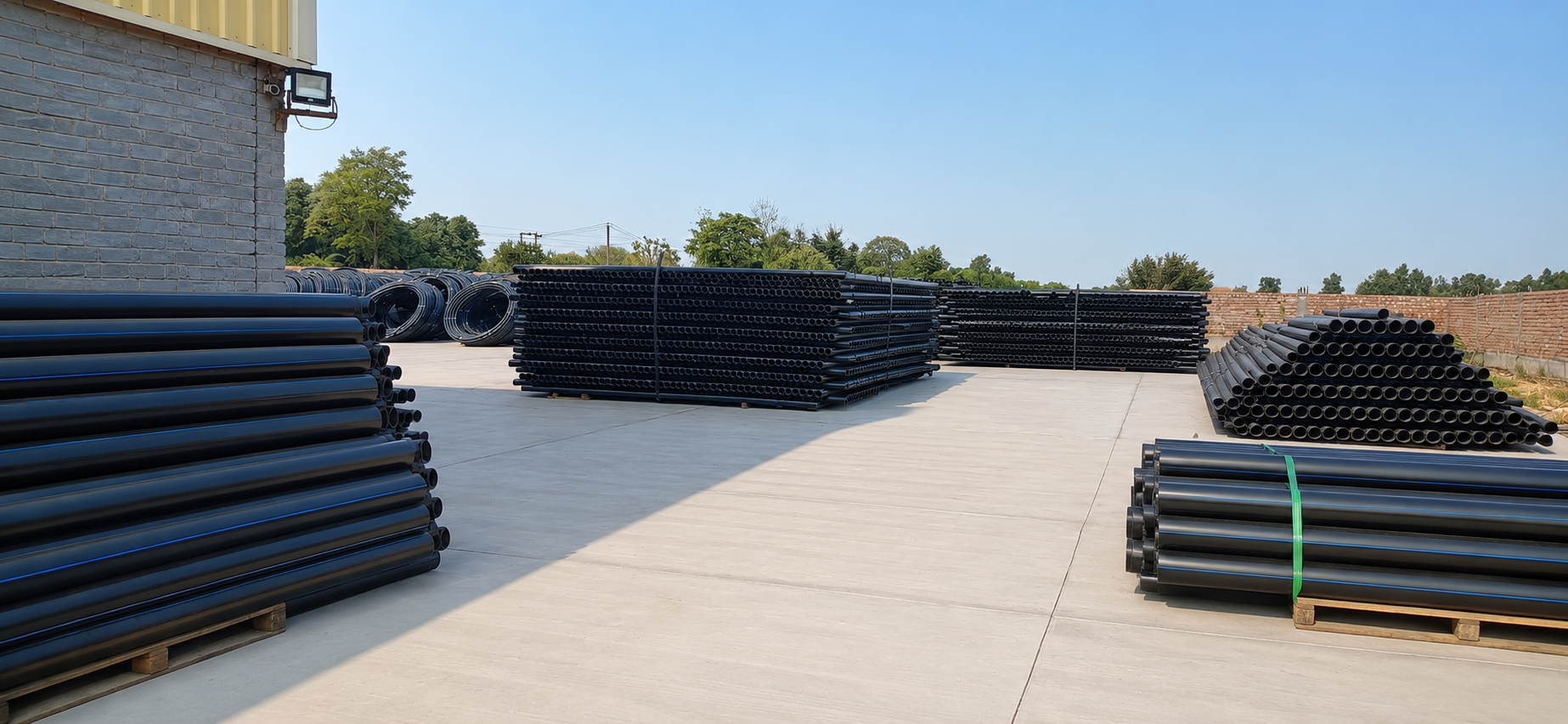
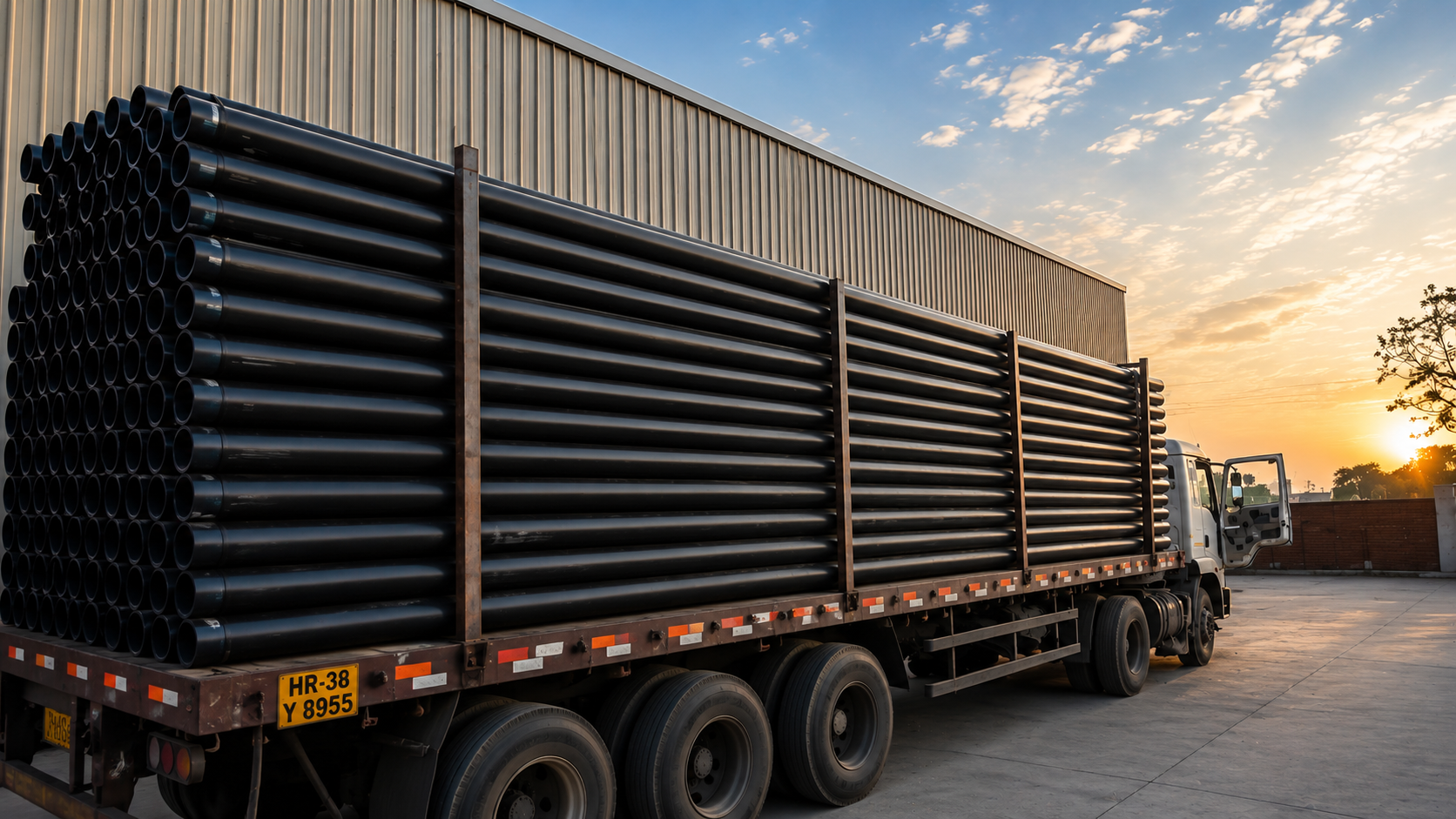
Store HDPE pipes on flat ground, stacked height not exceeding 1.5 m for large sizes, covered from direct sunlight for storage exceeding 6 months. Coils should be stored on flat ground with strapping intact. During handling, avoid dragging pipes on abrasive surfaces — use webbing slings and forklifts with padded tines.
Step 10: Choose a partner, not just a supplier
Buying HDPE pipes is a long-term relationship. Choose a manufacturer with proven BIS credentials, in-house testing, third-party inspection acceptance, and a technical team available for pre- and post-supply advice. Almax Polymers has 20+ years of experience across Jal Jeevan Mission, PHED, PMKSY, telecom and industrial projects — our engineering team is always available for specification and sizing support.