Why the choice of manufacturer matters
HDPE pipes carry drinking water, sewage, chemicals, telecom cables and gas. A poor-quality pipe can compromise an entire project for decades. The manufacturer you choose is not a commodity vendor — they are a long-term partner responsible for the integrity of your infrastructure. For Jal Jeevan Mission and PHED projects, sub-standard pipes translate into leaks, low-pressure complaints, repeat excavation and public inconvenience. A one-time saving of 5–10 percent on pipe cost can become a 5–10 crore repair liability across a district.
Verify BIS licence and IS 4984:2016 compliance
Any credible HDPE pipe manufacturer must hold a valid BIS licence for IS 4984:2016. Ask for a certified copy and cross-verify on the BIS Care portal. Check the licence expiry, licenced dimensional range and manufacturing location. At Almax, all HDPE pipes are manufactured strictly to IS 4984:2016 with regular internal and third-party surveillance audits. The BIS marking on our pipes carries manufacturer name, IS number, grade, OD, wall thickness, PN, batch code and shift — printed at intervals of not more than 1 metre.
Insist on 100% virgin polyethylene
Recycled or reprocessed material dramatically shortens service life. Reputable manufacturers use virgin PE 63, PE 80 or PE 100 compounds from OEM petrochemical suppliers such as HMEL, Reliance, GAIL, Borouge and Sabic. Request raw material Test Certificates (TCs) for every batch and cross-verify supplier stamps. Reprocessed material is easily identified through MFI drift, low OIT (Oxidation Induction Time), poor carbon black dispersion and dimensional instability. Almax maintains raw-material traceability from supplier bag number to finished pipe batch.
Assess in-house testing infrastructure
Look for a manufacturer with an in-house laboratory performing hydrostatic pressure tests, MFI, density, carbon black content, dispersion and dimensional checks. Hydrostatic burst equipment (per IS 12235) is expensive — many small units outsource it, which is a red flag for long project supplies. Almax’s in-house lab tests every batch before dispatch and archives reports for a minimum of 5 years.
Third-party inspection readiness
A serious manufacturer is inspection-ready every day — not just when a client visits. Almax routinely coordinates inspections with CIPET, RITES, SGS, PDIL and Crown Agents at both raw-material and finished-good stages. Ask for sample inspection reports from recent dispatches. For central and state-government tenders, third-party inspection acceptance is a mandatory qualification criterion.
Production capacity and delivery track record
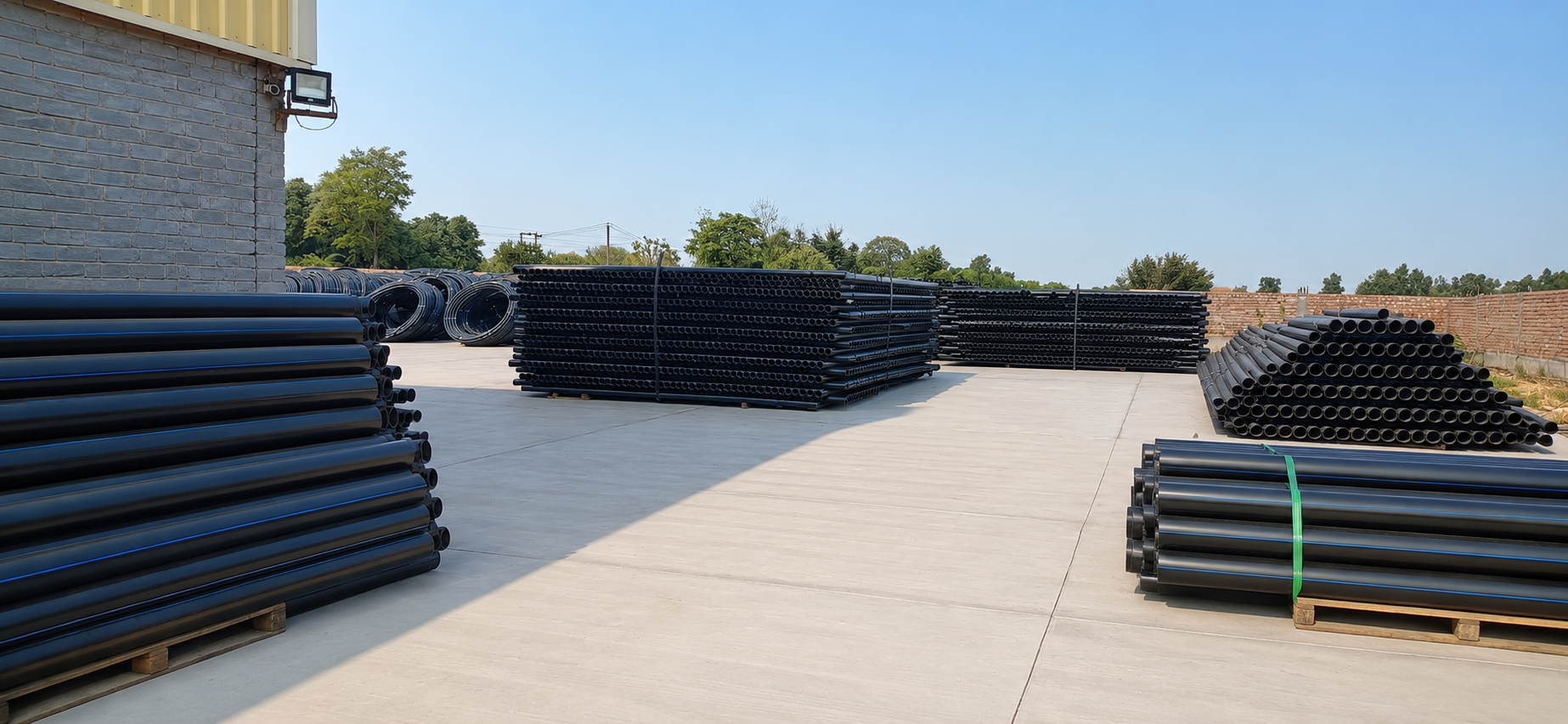
Verify the manufacturer’s monthly and annual production capacity, and reference dispatches to similar-scale projects. A supplier promising 500 MT per month but delivering only 200 MT will break your project schedule. Almax operates at approximately 10,000 MT annual capacity with proven track record on Jal Jeevan Mission, PHED and Smart City projects across North India. Ask for a plant visit — refusal is a signal.
Commercial terms and after-sales
Look for transparent commercial terms (payment schedule, LC acceptance, on-time dispatch commitments), and a technical team that responds to installation queries after delivery. Reputable manufacturers accept Letter of Credit (LC) payments for government and export orders. Also confirm the availability of technical documentation — datasheets, MTC, BIS test reports, third-party inspection reports — as standard dispatch documents.
Red flags to walk away from
Refusal to allow plant visits. No BIS licence or expired licence. Inability to produce raw-material TCs. Sub-market pricing without explanation — typically indicates reprocessed material. Marking missing or inconsistent on sample pipes. No in-house lab. Refusal of third-party inspection. History of failed batches on past projects (check with peer procurement teams).
Final checklist before placing an order
Valid BIS licence with correct IS number, grade and range. Raw-material TC for the intended batch. Sample pipe for dimensional and marking verification. Written commitment on dispatch schedule with penalties. Third-party inspection acceptance. Signed technical specification annexure attached to the PO. Payment terms including retention against installation. With these in place, you are set up for a smooth, dispute-free supply.